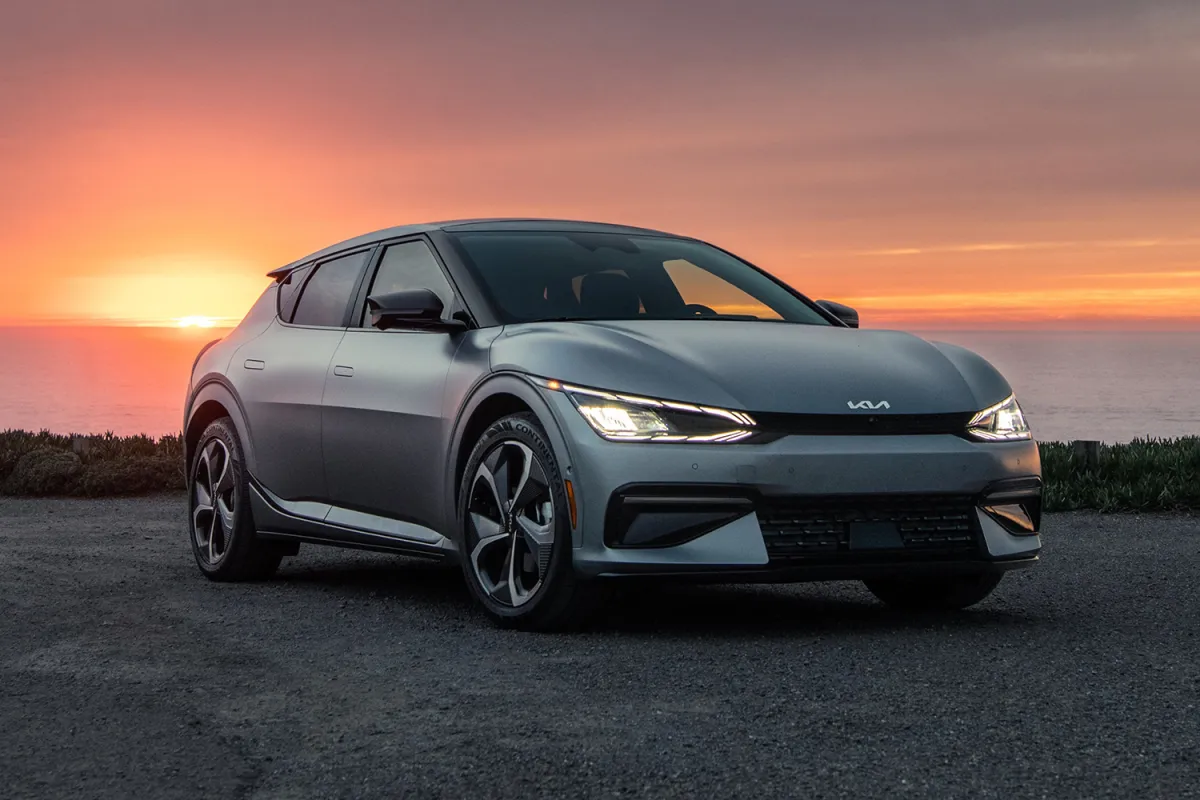
The Kia EV6 is a 5-door crossover all-electric vehicle, combining outstanding luxury and sporty use. While the Kia EV6 is not the first or only EV offered by Kia, it’s a higher-end car than its other electric option, the Kia Niro.
The EV6 will look cool and won’t cost too much – so look out for more on the road. The Kia EV6 team at SolarReviews had their hands on a Wind RWD Kia EV6 and have experienced it for themselves, not just driving it on their commute to work every day, but also on state-to-state trips.
Let’s delve deeper into the Kia EV6 and what to really expect as a new EV6 owner.
Kia EV6 – What Should You Know About It?
First, let’s lay the groundwork for what exactly Kia’s all-electric SUV, the EV6, has to offer. The EV6 comes with a range of MSRPs from $41,400 to $56,400, depending on the trim level chosen. Currently, the Kia EV6 is not eligible for the federal EV tax credit.
The EV6 has a cooling and heating seat system, a display system that lets you know how much electricity your car uses when driving, adaptive cruise control, and 120-volt in-car charging, which allows you to charge your laptop.
It comes in 5 trims with exclusive features on each. There are three different models you can choose from: the EV6 Light, EV6 Wind, and EV6 GT Line.
Other than the stylish touches such as a wide sunroof or door handles that extend automatically, the main distinctions between the trims are aspects such as horsepower and driving range. Moreover, the Light RWD is equipped with a smaller battery, which helps it to stay affordable, but also has a shorter range than all other Kia EV6 models.
The EV6 appears to offer a lot of exciting options, but is it realistic for the masses?
Which Kia EV6 Model Did We Test Drive?
The Kia EV6 Wind RWD is powered by a 77.4 kilowatt-hour (kWh) battery with a 310-mile EPA range in Glacier. That works out to about 4 miles per kWh of charge. While the Kia Connect app features a car locator, the EV6’s already distinctive styling and Glacier colour will help you not lose your car in a parking lot.
The EV6 gets points for the quality of the interior, too. All of the materials felt sturdy and of a higher quality compared to other EVs we’ve been in (sorry Tesla). There is no transmission between the cockpit and seats, so the space between these two is well suited for storage and makes the car feel larger. The sheer quietness of the car while you’re driving it is impressive, too – especially when you’re used to driving a 2011 gas guzzler.
We weren’t so crazy about controlling the temperature while driving. If you don’t have climate control up, you’ll need to press another button to change screens on the infotainment system. If you feel like changing the song or just want to see how long your podcast is going, then you’ll need to return to the media screen. There were some controls for the media on the steering wheel, although it was a bit cumbersome to operate while driving.
How Does the Kia EV6 Handle Everyday Driving?
Our daily commute is about 73.32 miles round trip daily and consists mostly of highway driving. According to Kia’s specs, this trip should consume 24% of the car’s battery.
What was the actual performance of the EV6? The energy consumed to drive to and from SolarReviews’ office was approximately 20.9 kWh, which represents approximately 28% of the energy stored in the battery.
Driving the Kia EV6 with other drivers on actual roads consumes more of the battery than what Kia has claimed, so our range is more likely to come down to 270 miles than 310.
While it’s a little disappointing to see the range isn’t as high as advertised, that’s to be expected. Don’t forget that even your gas car doesn’t get the exact MPG that is listed. The range of an EV and its gas miles vary with driving habits, road conditions, and the type of fuel in your vehicle.
270 miles is still quite a bit of range, particularly for commuting to and from work. We were able to reach our office without any problems, and we have ample battery to drive to and from work for the next 2 days without charging.
How Long Does It Really Take to Charge a Kia EV6?
We did not have to charge our EV6 on our drive to work, and we did do it! We used a Level 1 charger that uses a typical home outlet and charges at 15 amps. Overnight, that brought our battery back up to a 95% charge.
So this is not too bad! Obviously, it took 8 hours to add approximately 25%, but we did not have to deal with any inconvenience for it. But if we weren’t using the Kia EV6 as our daily driver, we don’t think we’d want to rely on a Level 1 charger to keep it topped off. We would likely end up spending money to get a Level 2 charger installed to charge the EV6 up much quicker, and we would be even more likely to do that if we could do it with an EV6.
In order to truly test out the Kia EV6, we decided to drive it from New Jersey to Vermont on a weekend. We were travelling to Vermont when we stopped for cider making, which added another 287 miles to the trip. From the driving experience, we’d have to charge at a charging station to get us to the office, but we’d most likely make most of the trip on a single charge.
Charging stop 1
It took us about 2 hours and 45 minutes to drive from our house to the cidery, a total distance of 163.42 miles. This meant that we had approximately 53% battery life remaining. At this rate, we were consuming just 4.5 miles per kWh, and that’s to the benefit of Kia’s EPA estimates!
However, we didn’t want to risk running out of battery, so we located a charging station 2.5 miles away that was an EVgo. It was a 50 kW charger, which was not as quick as some of the other charging stations, but we spent around 45 minutes at the station, getting us up to around 80% charged before we got back on board and hit the road again.
It has cost us $11.70 to charge it up. The cost of the same amount of gas to fill a conventional SUV would be just under $17.
Charging stop 2
Following a cidery broken, we started off on our way to our destination. We drove an additional 105.63 miles and used 39% of the battery. We used a bit more energy per mile that we drove this time around, depleting the battery faster.
To be extra safe, we stopped at a public charging station in Rutland, Vermont at 150 kW. This charger was significantly more powerful than the previous public charger we used, so we charged our battery to 64% for about 15 minutes at this stop, paying approximately $5.60 to get there, before the home stretch.
Reaching our Destination
It took us just 26 minutes to get to our ski resort destination from the second public charging station. This brought us down to a 55% charge. We spent a total of four days at the resort, during which we didn’t take the car out or charge it at all.
Charging stop 3
Our weekend trip was over, and it was back to New Jersey. We were in Rutland for about 7 miles and then headed back to the same EVgo station in Rutland for 33 minutes of charging. This resulted in our battery being 90% charged for $11.55.
The car gave us an estimated range of 245 miles based on the 255-mile route to get home. Don’t worry, later on in the trip, 10 or so additional miles were required, but this would be quite easy at a rest stop.
Charging stop 4
The first attempt to get a quick charge was south of Albany, NY. The car navigation system took us to a rest stop that had one available EV charging station, but it was occupied by another EV driver. There was still a fair distance of battery life remaining, so we thought we’d probably better not wait and continued on to another rest stop 25 miles away.
Charging stop 5
Sadly, we encountered another tree blocking this rest stop. The EV charger was damaged. We had 44% battery left at this point. Enough to move us to another charging station but not to our home.
Charging stop 6
The next choice was an outlet store with public charging stations 60 miles away. However, EVs were parked in the charging spaces by non-charging vehicles.
For those keeping track, the car has about 14% battery left at this point.
Charging stop 7
There was an open charger available at a nearby Mercedes-Benz dealership, but it was only suitable for Mercedes owners. We’re now below 10% charge on our battery.
So we opted to download the individual charging station apps for EVgo, ChargePoint, and EVconnect rather than just rely on Kia’s built-in map of chargers, in hopes of better luck.
Charging stop 8
Lastly, EVgo took us to one of its open and functional charging stations where our battery had merely 1% charge remaining. We were three miles away and would have been stuck.
We didn’t need to charge for a long time as we were very close to home. We spent 20 minutes there, which charged the battery to 14.4 kWh, and we were able to come home safely. We paid about $7.00 for this charge.
Home Sweet Home
To reach the last charging station and then return to our garage, we consumed 7.5 kWh. Finally, we connected the EV6 to our level 1 charger to juice up the car overnight in order to return to the SolarReviews office on Monday.
Kia EV6 – What Are the Key Takeaways?
Moral of the story: When it comes to commuting to work and running simple errands, the Kia EV6 is great when you have a charger at home. With the majority of drivers in the United States using their vehicles for transportation, the Kia EV6 is certainly worth considering. Not quite as costly as high-end EVs available, but still comes with impressive specifications.
But long-distance travelling… Not so sure that charging infrastructure in the U.S. is quite ready for all to go out on EV road trips. Our drive to Vermont wasn’t too bad, but the drive home was just shy of disaster. Yes, it saved gas money, but we were aggravated and took a couple of hours to navigate the way to a working, available charging station. In the years to come, we could do a little more planning of the trip to the charging station to make it a little less stressful.
For those who are looking for a new car, however, and don’t need to travel more than 250 miles at a time, the Kia EV6 is a good option to consider. While you may make the occasional weekend getaway, most problems can be prevented by planning ahead of your trip. The EV6 is a modern, sleek, and reliable vehicle! Oh, and it’s green, and it helps you save money on your gas bill. If an EV is your next purchase, you should think about putting in solar panels with it, so you can save on your EV and not have to pay anything to charge your car!
Frequently Asked Questions (FAQs)
1. Is the Kia EV6 a new vehicle?
The Kia EV6 is a fully electric crossover with a contemporary exterior, generous interior, some powerful performance, and a long-range driving experience.
2. What was the reason behind the creation of the Kia EV6?
The EV6 has a smooth, quiet, and responsive ride. The instant electric torque provides rapid and fun acceleration.
3. What is the performance of the Kia EV6?
The EV6 offers excellent acceleration and capable handling. For drivers who are looking for more power, there are higher-performing versions available.
4. The Kia EV6 has a driving range of what?
All ranges are dependent on the model, battery, wheels, and driving conditions. The ranges of EV6s may vary greatly between different models.
5. How long does the Kia EV6 take to charge?
Charging time is dependent on the charger and battery version. The EV6 can be recharged faster than with a standard home charger if using a suitable fast charger.
6. Will the Kia EV6 deliver the smooth ride you expect and value?
Yes. For commuting and extended trips, the EV6 offers a pleasant ride, a comfortable interior, and cushioned seating.
7. What are the pros and cons of the Kia EV6?
The EV6 provides useful cargo capacity and space for passengers for day-to-day use. It has a crossover-type design, which means that it is both functional and sporty.